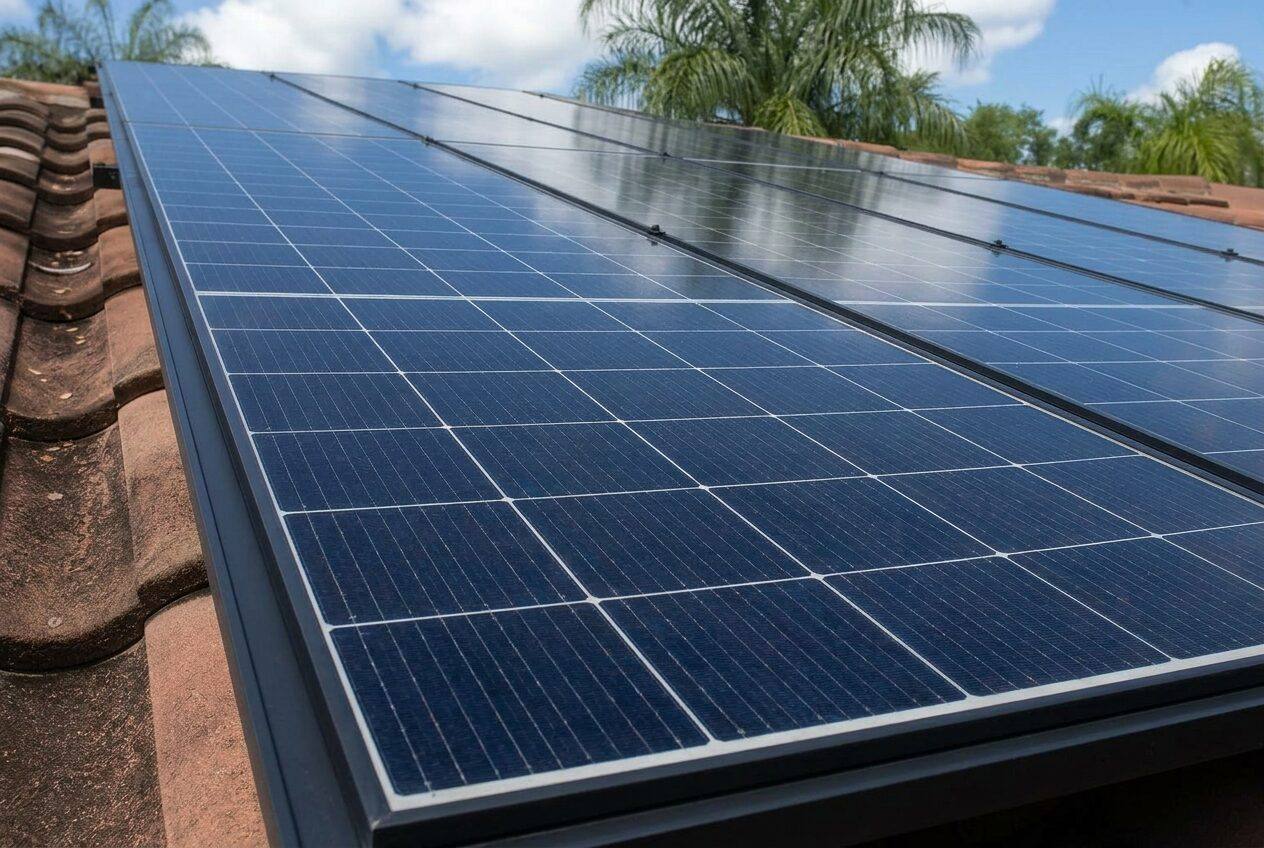
Solar Panel Cleaning · Miami

Commercial Solar Panel Cleaning in Miami & South Florida

Dust, salt spray, and bird droppings can cost a commercial solar array up to 30% of its output. Our drones clean entire arrays with pure water — no streaks, no microcracks, no foot traffic on the modules.

Drone cleaning a commercial solar panel array

Fully Insured

$2M Liability

FAA Compliant

Part 107 Certified

Commercial Projects

Up to 200+ ft

The Problem

Dirty panels quietly burn revenue every month

Most operators skip cleaning because hand-washing large arrays is slow and dangerous. Manufacturers warn that walking on modules causes microcracks that void warranties.

Our Solution

Aerial pure-water cleaning, panel-safe

Our drones apply de-ionized water in a controlled spray pattern. No detergents, no abrasion, no contact. Output recovery is typically measurable within the next billing cycle.

Why drone cleaning wins

Recover up to 30% of lost solar output

No foot traffic, no microcrack risk

Pure de-ionized water — no chemical residue

Clean a 1MW array in a single day

Maintains panel warranty compliance

Recurring maintenance plans available

Common use cases

  • Commercial rooftop arrays
  • Warehouse & logistics solar
  • Solar farms & utility arrays
  • Carport & parking canopies
  • Schools, government & municipal sites

Transparent project pricing

Solar cleaning projects start at $0.04–$0.08/watt for commercial arrays. Volume pricing for utility-scale sites. Quarterly and bi-annual maintenance plans available.

Request a Site Quote
Drone Cleaning FAQ

Looking for alternatives to scaffolding?

See how commercial properties across Miami are cleaned without scaffolding, boom lifts, or rope access — safer, faster, and 30–60% more cost-efficient.

Get a free quote in 24 hours

Tell us about your property. We'll send a fixed-price proposal — no scaffolding, no surprises.

Quick answer

What is drone solar panel cleaning in Miami?

Drone solar panel cleaning in Miami uses a tethered industrial drone to spray de-ionized pure water across commercial solar arrays — rooftop, carport, and ground-mount — without any foot traffic on the modules. Pure water has zero dissolved solids, so panels air-dry streak-free with no detergent residue and no microcrack risk from panel-walking. South Florida arrays lose 15–30% of output between cleanings to salt aerosols, Saharan dust, and bird soiling; drone cleaning recovers that output within one billing cycle.

Service area
Miami-Dade, Broward, Palm Beach
Output recovered
Up to 30%
Water
De-ionized (0 TDS) pure water
Module contact
Zero — no microcracks
Speed
1MW cleaned per day
Warranty
Panel-manufacturer approved
Frequently asked

Drone cleaning, answered

How much does drone solar panel cleaning cost in Miami?+

Commercial drone solar cleaning in Miami starts at $0.04/watt, with volume pricing for utility-scale arrays. A 250 kW Miami rooftop typically falls between $8,000 and $12,000, and quarterly maintenance plans reduce per-visit pricing 20–30%.

Will drone cleaning void my solar panel warranty?+

No — the opposite. Major panel manufacturers explicitly warn against foot traffic on modules because it causes microcracks. Drone pure-water cleaning involves zero panel contact and no detergents, keeping warranties intact across every major brand installed in South Florida.

How often should Miami solar arrays be cleaned?+

Quarterly for coastal arrays in Miami-Dade and Broward (salt aerosols and Saharan dust build up fast), and twice yearly for inland sites in Palm Beach and western Broward. Bird soiling and pollen can drop output 15–30% between cleanings.

Why pure water instead of soap?+

De-ionized pure water has zero dissolved solids, so it air-dries completely streak-free — no residue, no shadowing, no detergent left to attract dirt. It's the standard for any solar cleaning that has to preserve output and warranty status.

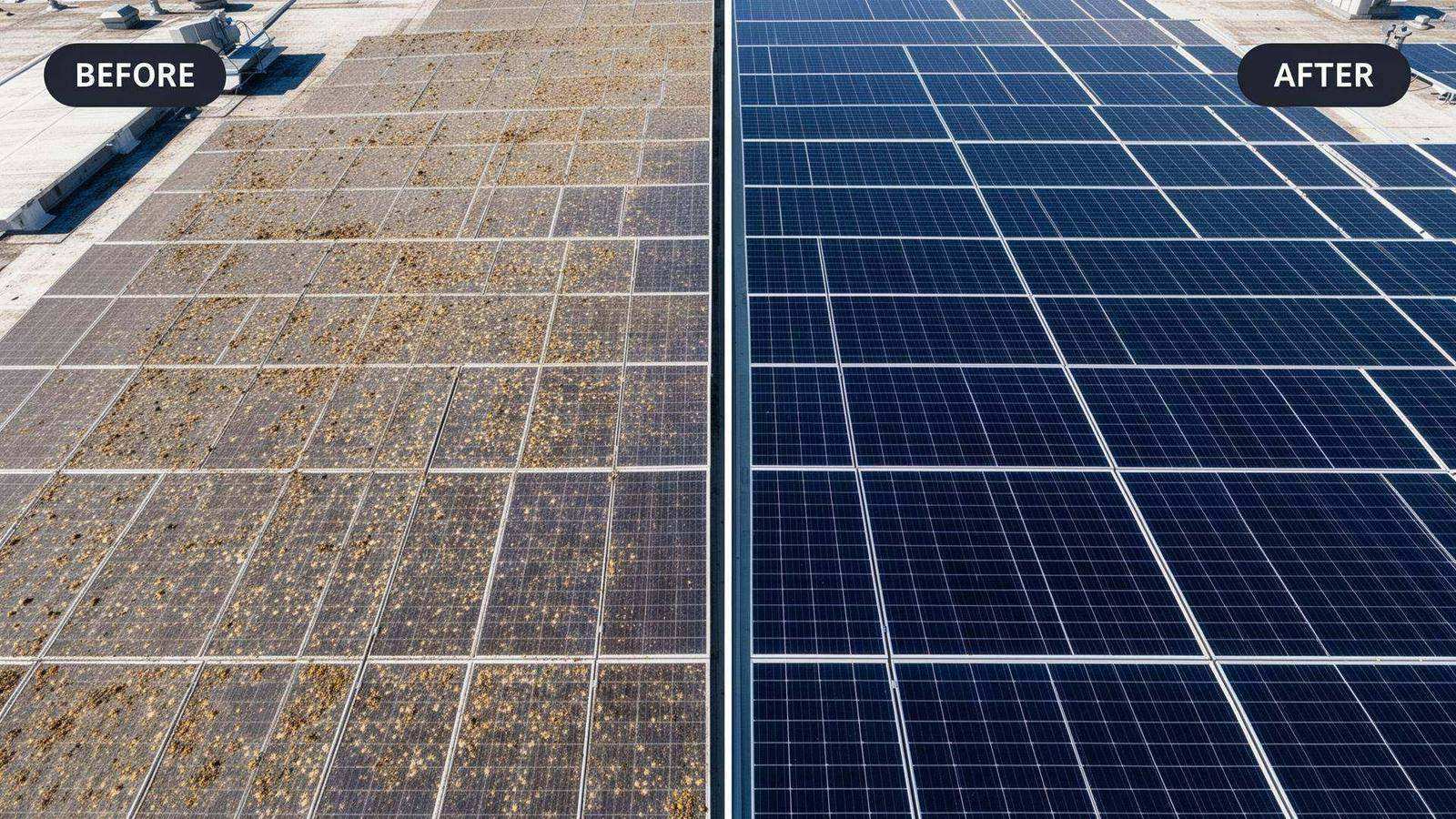
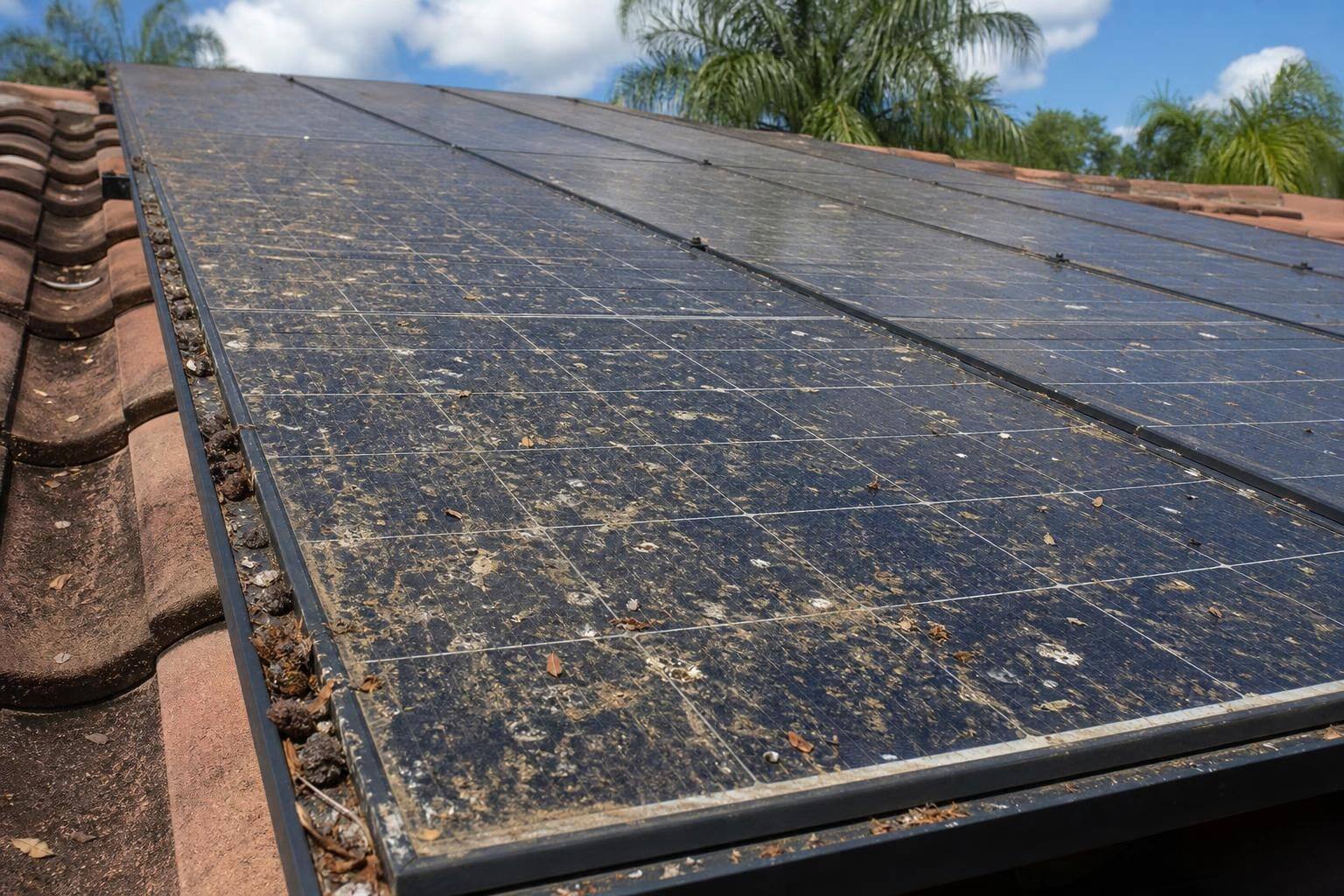
Before & after

Recover lost output, panel-safe

Pure de-ionized water cleaning — no detergents, no foot traffic, no microcracks.

Before — Rooftop solar panel array cleaningBefore
After — Rooftop solar panel array cleaningAfter
Residential rooftop array · pure-water clean · output recovered
Step-by-step process

How drone solar panel cleaning works, start to finish

Every Miami-Dade, Broward, and Palm Beach array gets the same controlled, documented workflow — from production analysis through 4K proof-of-clean delivery.

  1. 1

    Array assessment & production baseline

    We pull the array's recent production data to establish a baseline, then aerially photograph the modules to map soiling severity by row. Heavy bird-soiling, salt crust, and Saharan dust loading get priority sequencing.

  2. 2

    Flight plan & LAANC airspace authorization

    A flight plan is filed with the EPC or asset manager. In controlled airspace near MIA, FLL, or PBI we request LAANC airspace authorization from the FAA before mobilization.

  3. 3

    Pure-water generation & ground pump staging

    Water is filtered through reverse osmosis and de-ionization beds to 0 TDS — the only chemistry that air-dries streak-free without detergent residue. The ground pump and water tank stage near the array within tether reach.

  4. 4

    Optional low-pressure soft-wash pre-treatment

    For heavily soiled panels with dried droppings or stubborn crust, a low-pressure soft-wash dwell precedes the rinse — biodegradable detergent that lifts the soiling without leaving residue.

  5. 5

    Pure-water flood rinse, row-by-row

    The drone flies continuous passes across every row, flood-rinsing modules with 0 TDS pure water. Panels air-dry streak-free — no squeegee, no detergent residue, no microcrack risk from panel walking.

  6. 6

    Output verification & 4K documentation

    4K aerial footage is delivered to the asset manager along with a production verification on the next billing cycle, proving the output recovery in dollars.

Equipment & specs

Solar cleaning drone equipment & specs

An engineered pure-water system — industrial tethered drone, RO/DI water generation, ground pump, FAA-certified pilot. Zero panel contact.

Drone class
Industrial tethered UAS
Payload
Twin pure-water nozzles
Reach
Rooftop, carport, ground-mount
Water purity
0 TDS de-ionized
Cleaning speed
~1 MW per day
Cleaning pressure
Low-pressure flood rinse
Wind rating
Sustained 25–30 mph
Pilot cert
FAA Part 107 commercial
Documentation
4K aerial + output verification
Safety, insurance & compliance

Safety, insurance & warranty compliance

Drone solar cleaning eliminates the two warranty-killing risks in traditional panel cleaning: foot traffic on modules (microcracks) and detergent residue on anti-reflective coatings.

Zero panel contact, zero microcracks

Major panel manufacturers (LG, Q Cells, Canadian Solar, Trina, JinkoSolar) all warn against foot traffic on modules. Drone pure-water cleaning involves zero contact, preserving warranty status across every brand.

No detergent, no AR-coating degradation

Detergents leave residue that attracts dust and can degrade anti-reflective coatings over time. 0 TDS pure water leaves nothing behind — the panel-manufacturer-approved cleaning chemistry.

FAA Part 107 + LAANC compliance

Every flight is conducted by an FAA-licensed Part 107 commercial pilot. LAANC authorizations are filed for controlled airspace near MIA, FLL, and PBI. Documentation is on every job site.

$2M commercial general liability + UAS coverage

We carry CGL plus dedicated UAS (drone) liability and hull coverage. Certificates of insurance naming the array owner, EPC, asset manager, or off-taker are issued before mobilization.

No fall risk on rooftop arrays

Rooftop solar cleaning by hand creates fall exposure on every visit — modules are slick when wet and inverters are often near the edge. Drone cleaning keeps crews on the ground entirely.

Verified output recovery

Production data is pulled before and after cleaning, proving the output recovery in dollars on the next billing cycle. Asset managers and owners get measurable ROI documentation, not just clean photos.

Pricing ranges

Drone solar panel cleaning pricing in South Florida

All projects are fixed-price after a free array assessment. Typical ranges for Miami-Dade, Broward, and Palm Beach:

Small commercial (50–250 kW)

$2,500 – $12,000

  • Full pure-water rinse
  • Optional soft-wash pre-treatment
  • 1-day completion
  • 4K aerial documentation
  • COI for array owner

Mid-array (250 kW – 1 MW)

$12,000 – $40,000

  • Row-by-row flood rinse
  • Production baseline & verification
  • 1–3 day completion
  • LAANC airspace coordination
  • Quarterly contract available

Utility-scale (1 MW+)

$0.04 – $0.06 / watt

  • Multi-day mobilization
  • Dedicated drone crew
  • Output recovery verification
  • EPC / asset-mgr reporting
  • Volume per-watt pricing

Final pricing depends on array size, format (rooftop/carport/ground-mount), soiling level, and frequency. Quarterly contracts cut per-visit pricing 20–30%. Utility-scale and multi-site portfolios get volume per-watt pricing.

Frequently asked

Drone solar panel cleaning FAQ

How does drone solar panel cleaning actually work?+

A tethered industrial drone carries twin pure-water nozzles fed by a ground pump pushing de-ionized water (0 TDS) up the tether. The drone flies row-by-row across the array, flood-rinsing every module with pure water. Because the water has zero dissolved solids, panels air-dry streak-free with no detergent residue — and no one walks the modules.

Why is pure water better than soap for solar panels?+

Detergents leave residue that attracts more dust and dims output between cleanings. Pure de-ionized water (0 TDS) carries no minerals, so it air-dries completely clear. It's also the only cleaning method that doesn't trigger panel-manufacturer warnings about chemical degradation of anti-reflective coatings.

Will drone cleaning void my solar panel warranty?+

No — and in many cases it's the only method that preserves warranty status. Major panel makers (LG, Q Cells, Canadian Solar, Trina, JinkoSolar) explicitly warn against foot traffic on modules because it causes microcracks that drop output and void warranties. Drone pure-water cleaning involves zero panel contact.

How much output can drone cleaning actually recover?+

South Florida arrays typically lose 15–30% of output between cleanings to a combination of salt aerosols, Saharan dust events, pollen, and bird soiling. Drone pure-water cleaning recovers that lost output — measurable on the next billing cycle's production report.

How much does drone solar panel cleaning cost in Miami?+

Commercial cleaning runs $0.04–$0.08 per watt depending on array size, access, and frequency. A 250 kW Miami rooftop typically falls between $8,000 and $12,000. A 1 MW utility or warehouse array runs $25,000–$40,000. Quarterly contracts cut per-visit cost 20–30%.

How fast can a drone clean a megawatt array?+

Approximately 1 MW per day. Drone cleaning is dramatically faster than hand-cleaning crews because there's no ladder work, no walking the modules, no harness setup, and no need to clean panel-by-panel — the drone flood-rinses entire rows in continuous passes.

How often should Miami solar arrays be cleaned?+

Quarterly for coastal arrays in Miami-Dade, Broward, and Palm Beach because salt aerosols and Saharan dust build up fast. Twice yearly for inland sites in western Broward and Palm Beach. Bird and pollen seasons can warrant additional cleans on sensitive sites.

Do you need FAA permission to fly a solar cleaning drone in Miami?+

Yes. Every flight is conducted under FAA Part 107 by a licensed commercial pilot. In controlled airspace near MIA, FLL, and PBI we file LAANC airspace authorizations before mobilization and carry the certificate on every job site.

What insurance do you carry for drone solar cleaning?+

We carry $2M commercial general liability plus dedicated UAS (drone) liability and hull coverage. Certificates of insurance naming the array owner, EPC, asset manager, or off-taker are issued before mobilization on every project.

Can you clean carport, canopy, and ground-mount arrays?+

Yes — drone cleaning handles all three formats. Rooftop arrays where walking the modules is unsafe, carport and parking canopies where ladder access is awkward, and ground-mount or solar-farm arrays where speed is the main constraint. 1 MW per day applies across all formats.

Does pure-water cleaning work on bird droppings and Saharan dust?+

Yes. The pure-water flood rinse breaks surface tension on dried droppings and dust crusts and sheets them off the module surface. For heavily soiled panels, a low-pressure soft-wash dwell can precede the rinse — still no detergent residue, still no panel contact.

Do you provide before-and-after output documentation?+

Yes. We deliver 4K aerial footage of every section before and after cleaning, plus electroluminescence-style proof of pane-by-pane clean. Output recovery is verified against the next production report and shared back to the asset manager or owner.
Local Coverage

Solar panel cleaning across South Florida

We clean commercial solar arrays across Miami-Dade, Broward, and Palm Beach. Each county has its own dust profile and access challenges — and drone pure-water cleaning works for all of them.

Miami-Dade

Miami-Dade County

Miami-Dade rooftop and carport solar arrays lose output fast to salt aerosols, construction dust, and Saharan dust events. Drone pure-water cleaning recovers production without anyone walking the modules.

  • Miami
  • Doral
  • Hialeah
  • Homestead
  • Kendall
  • Aventura
  • Miami Beach
Broward

Broward County

Broward's warehouse rooftops and logistics centers host some of South Florida's largest commercial arrays. Aerial cleaning finishes a 1MW Broward rooftop in a single day with zero foot traffic on the panels.

  • Fort Lauderdale
  • Pembroke Pines
  • Sunrise
  • Davie
  • Coral Springs
  • Pompano Beach
  • Plantation
Palm Beach

Palm Beach County

Palm Beach solar farms, agricultural arrays, and HOA carports collect a heavy mix of pollen, fertilizer dust, and bird soiling. Pure-water drone cleaning restores output without chemicals or warranty risk.

  • Boca Raton
  • West Palm Beach
  • Delray Beach
  • Wellington
  • Jupiter
  • Boynton Beach

Local FAQs — Miami, Broward & Palm Beach

Do you clean commercial solar panels in Miami-Dade County?

+

Yes — we clean rooftop and ground-mount commercial arrays across Miami-Dade, including Miami, Doral, Hialeah, Homestead, Kendall, Aventura, and Miami Beach. Most Miami-Dade arrays are cleaned in a single mobilization with measurable output recovery the next billing cycle.

Do you offer drone solar panel cleaning in Broward County?

+

Yes. We clean commercial solar in Fort Lauderdale, Pembroke Pines, Sunrise, Davie, Coral Springs, Pompano Beach, and Plantation. Broward warehouse and logistics arrays are a strong fit for drones because the roofs are large and panel-walking is unsafe.

Can you clean solar farms and arrays in Palm Beach County?

+

Yes — we serve Boca Raton, West Palm Beach, Delray Beach, Wellington, Jupiter, and Boynton Beach. Drone pure-water cleaning is approved by major panel manufacturers because there is no detergent residue and zero foot traffic on the modules.

How often should South Florida solar panels be cleaned?

+

In Miami-Dade, Broward, and Palm Beach we recommend quarterly cleaning for arrays near the coast or in heavy-pollen zones, and twice-yearly cleaning for inland sites. Saharan dust events and bird soiling can drop output 15–30% between cleanings.

ROI · Payback · Output verification

Drone solar panel cleaning — common questions

Direct answers for asset managers, O&M teams, EPCs, and off-takers comparing drone pure-water cleaning to manual hand-cleaning and robotic rail systems.

How do I prove the production lift from drone solar cleaning to my asset manager or off-taker?+

Compare the 30-day average kWh production for the period immediately before cleaning to the 30-day average immediately after. We deliver the pre/post 4K aerial footage and a one-page output report referencing your monitoring platform (Enphase, SolarEdge, Locus, AlsoEnergy, etc.). Most South Florida arrays show a 12–25% production lift in the first billing cycle after cleaning — directly attributable revenue that funds the cleaning program.

What's the financial payback period on drone solar cleaning for a commercial array?+

On a 250 kW Miami rooftop with 18% soiling-related output loss and $0.11/kWh effective rate, the lost annual revenue is roughly $4,800. A $9,500 quarterly-contract cleaning program recovers most of that and pays back inside the second cycle. Larger 1 MW+ arrays with higher tariffs and worse coastal/dust exposure typically see 1.5–3 month paybacks per cleaning.

Does drone cleaning work on bifacial modules and tracker-mounted arrays?+

Yes — both formats actually clean faster. Bifacial modules benefit from cleaner back surfaces too; the drone overflight cleans the front and any rear soiling rinses with the runoff. Tracker arrays are pre-set to flat (0° tilt) before cleaning so the flood-rinse sheets uniformly across every row. Single-axis trackers and dual-axis trackers both work.

Can you clean solar arrays without taking them offline?+

Yes. Pure-water cleaning is non-conductive at 0 TDS and does not require module-level shutdown. The array continues producing during cleaning — we typically see real-time output start climbing in the monitoring platform within minutes of the first row being rinsed. For utility-scale sites, we coordinate with the O&M team but don't trigger curtailment.

How does drone cleaning compare to robotic rail-mounted panel cleaning systems?+

Robotic rail cleaners (Ecoppia, SunBrush, BladeRanger) are fixed-asset installations averaging $15,000–$40,000 per MW of capex plus ongoing maintenance, and they only fit specific rack geometries. Drone cleaning is a flexible service with zero capex, works on every rack geometry including legacy installations, and adapts to weather and soiling events on demand. For new builds with optimal layouts, robotics can make sense; for existing fleets and mixed portfolios, drones almost always pencil out better.

Will pure-water cleaning damage panel anti-reflective coatings or junction boxes?+

No. Pure water at 0 TDS is the manufacturer-recommended cleaning fluid for every major panel brand (LG, Q Cells, Canadian Solar, Trina, JinkoSolar, REC, SunPower, Maxeon). It cannot damage anti-reflective coatings (no chemical reactivity), cannot damage encapsulants (no thermal stress), and cannot damage junction boxes (no contact, low rinse pressure).

Can you clean a hail-damaged or microcracked array during normal scheduled cleaning?+

Yes — and the cleaning itself documents existing damage with 4K aerial footage useful for insurance claims and warranty cases. Drone cleaning adds zero mechanical stress because nothing touches the modules, so it doesn't propagate existing microcracks. The pre-cleaning footage often becomes the baseline for an insurance claim our customer didn't know they had grounds for.

What to expect

From monitoring baseline to production lift report

A measurable workflow built around your monitoring platform — every visit ties back to verified kWh recovery.

  1. 01

    T-7 days: Monitoring baseline pulled

    We pull the prior 30-day kWh average from your monitoring platform (Enphase, SolarEdge, Locus, AlsoEnergy) as the production baseline. This is what the post-cleaning lift gets measured against.

  2. 02

    T-2 days: Site walk or aerial review

    For first-time sites we do a brief aerial review confirming array layout, access setbacks, water source, and any obstructions. Repeat sites skip this.

  3. 03

    Cleaning day, sunrise: Ground crew arrives

    Crew stages the pump, RO/DI water filtration to 0 TDS, tether reel, and drone. Trackers are pre-set to flat by the O&M team if applicable.

  4. 04

    Cleaning: Row-by-row pure-water rinse

    The drone flies continuous passes across every row flood-rinsing every module. The array stays online — real-time production typically starts climbing in the monitoring platform within minutes.

  5. 05

    Cleanup: Site walk and demobilize

    Crew breaks down, the staging area is restored, and any landscaping/walkway runoff is rinsed clean. Most rooftop and carport sites are demobilized within 60 minutes of the last row.

  6. 06

    T+30 days: Production lift report

    We pull the post-cleaning 30-day kWh average and deliver a one-page production lift report — exact percentage gain, kWh recovered, and dollar value at your contracted rate.